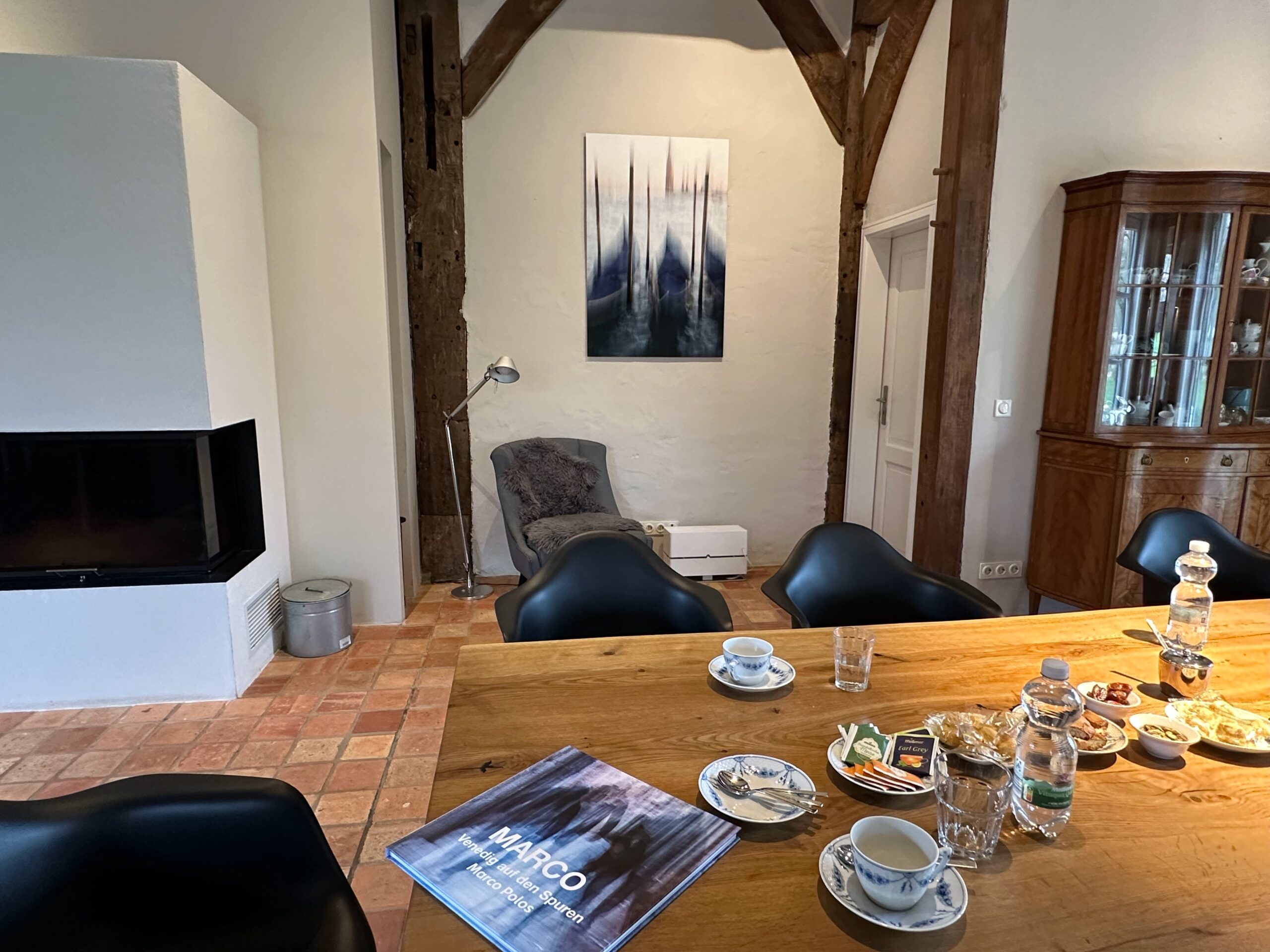
Haus Marck in Tecklenburg. Photo: Private
MARCO – VENICE speaks of the power of discovery, of Marco Polo’s innate openness to people and foreign cultures, and of the enduring mystery of Venice itself. In April 2024, a chance encounter led photo artist Monika Reimann directly to the site where the Venetian merchant once lived, marking the inception of this ambitious photographic body of work. Monika is not interested in the well-worn clichés of tourist Venice. Instead, she interrogates what we see, what we merely believe we see, and what truly lingers of a place in human memory.
We inhabit an age drowning in information, yet increasingly impoverished in genuine, contemplative perception. MARCO – VENICE is Monika’s artistic counterpoint to this modern tension. Her images coalesce out of light, kinetic movement, chance, and intentional blur. By refusing to delineate every detail, the photograph leaves vital space for the viewer’s own perception, personal memory, and emotional projection.
Spanning 2024 through 2028, this project embraces radical slowness as an integral component of the artistic process. Rather than succumbing to the rapid production of endless images, Monika asks which works sustain their ambiguity and openness over repeated viewings. From an archive of thousands of exposures, relevance is carved out through rigorous limitation: only seven pieces survive the selection each year.
Dialogue lies at the heart of this work. During Inspiration Week at the historic moated castle Haus Marck in Tecklenburg—a tranquil sanctuary in the Teutoburger Forest that Monika discovered during the COVID-19 pandemic—these seven annual works are unveiled to a circle of engaged guests. Ricarda Freifrau von Diepenbroick-Grüter, the owner of Haus Marck, champions continuity, fostering a trusted collaboration that grounds the project’s multi-year rhythm.
In the estate’s carriage house (Remise), seven new large-format works from the second series were exhibited this year, urging visitors to look closer. As an art historian, I have the privilege of joining Venetian historian Virginia Ghezzo to help moderate and support these interdisciplinary conversations alongside Monika. Gathered around each piece are artists, photographers, and entrepreneurs united by an explorer’s spirit reminiscent of Marco Polo.
Together, we center our discussions on two decisive questions:
What do I see in this image, and why do I see it this way?
The varied perspectives of the audience form the resonance chamber of the artwork. Because every viewer brings their own lived history, recollections, and imaginative lens, multiple distinct realities emerge from a single frame. Perception evolves into meaningful dialogue.
Development Phases: MARCO – VENICE
- 2025: Do we still need originals in digital times?
- 2026: A touch of eternity
- 2027: People and places
- 2028: Seeing the familiar anew in Venice
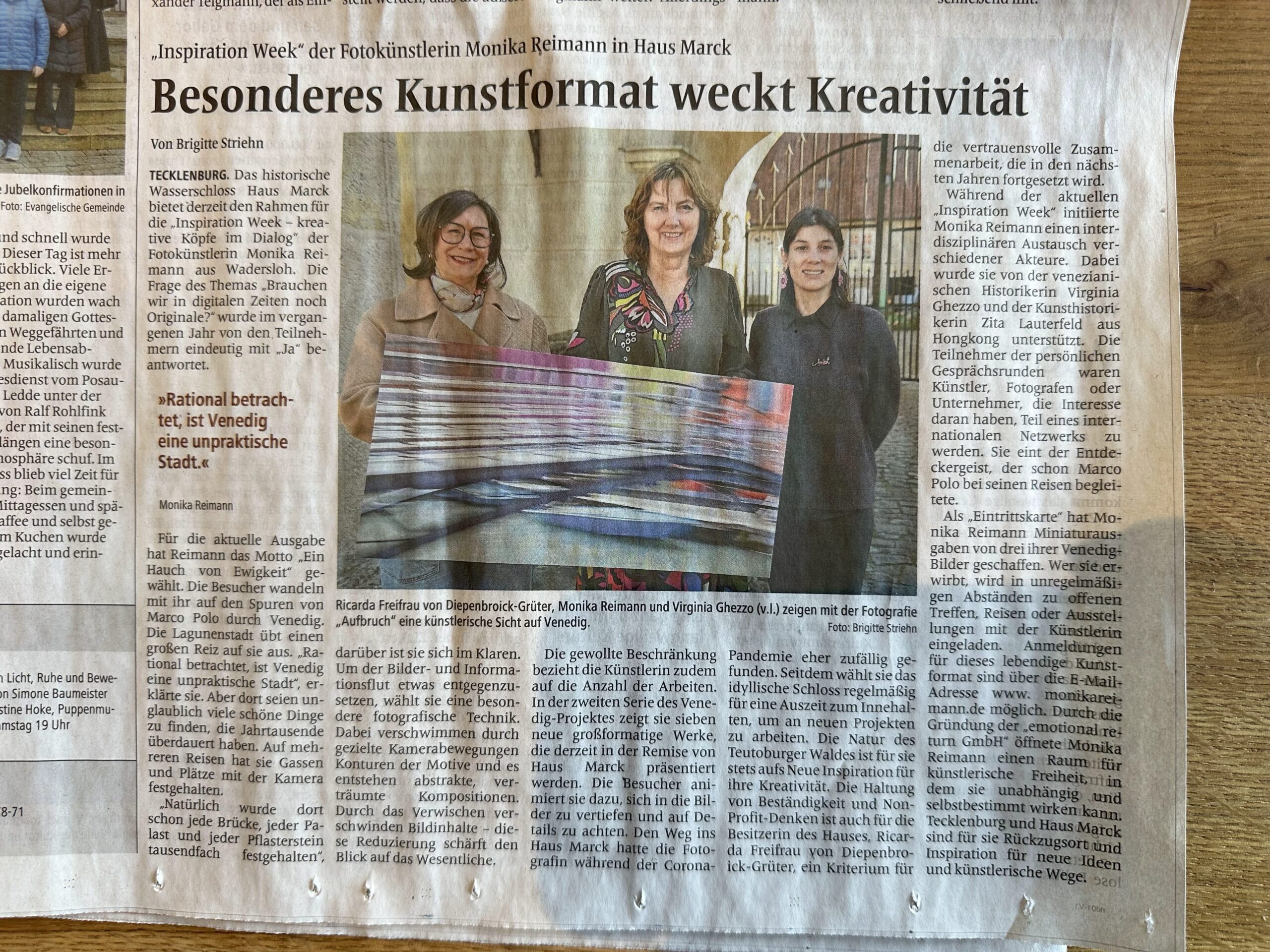
Ricarda Freifrau von Diepenbroick-Grüter, Monika Reimann, and Virginia Ghezzo (left to right) presenting the photograph Aufbruch during “Inspiration Week” at Haus Marck.
(Photo: Brigitte Striehn, published in the Tecklenburg local section, Saturday, 21 March 2026)
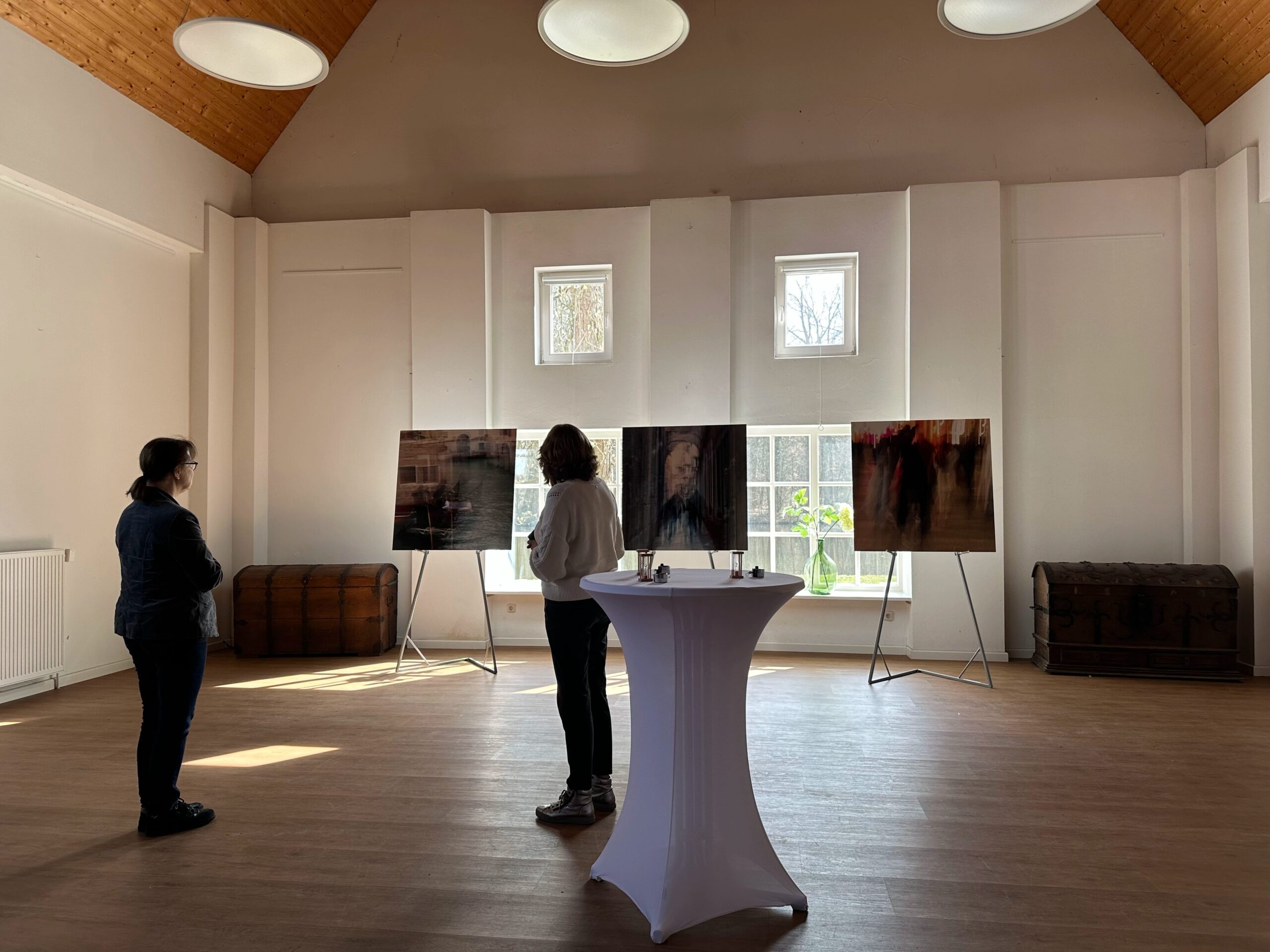
Haus Marck in Tecklenburg. Photo: Private